Publications
····
Our collection and recommendations transfer knowledge to improve the management of religious diversity.
LICREGDI Editions aim to disseminate studies carried out by specialists in the Laboratory's areas of work, such as freedom of belief and diversity management. This aims to be true to one of the institution's purposes, which is the transfer of research results carried out in the Laboratory's fields of study. In this way, the scientific community, public administrations, and society as a whole will be able to consult them easily. For greater accessibility, digital editions will be produced, which can be found on the LICREGDI website, without the Laboratory being responsible for the opinions expressed by the authors of the publications. Each volume has its own ISBN and is duly registered with the Intellectual Property Registry. The location of the copies will be disseminated through their inclusion in databases and search engines such as Dialnet or the National Library of Spain.
Authors who are interested in publishing in LICREGDI Editions should send their text to the following email address: licregdi@unizar.es indicating “publication proposal” in the subject line. Only original works will be published. From that moment, it will move to the original selection process under the terms indicated in the corresponding section. Ediciones del LIC REGI undertakes not to disseminate or send the received work to third parties.
Manuscripts must be sent in A4, PDF format, and must comply with the following formal requirements:
1. The originals must be written in one of the following languages: Spanish, English, French, Italian, or Portuguese.
2. Title of the work and identification of the author or, where applicable, the coordinator or director of the work.
3. Index (in the case of collective works, the authorship of each chapter will be indicated).
4. The titles of the sections and subsections within each chapter will follow the order and design set out below, which must be duly reflected in the overall table of contents of the work:
- 1. Religious Freedom in Spain
- 1.1. Sources
- 1.1.1. Unilateral
- 1.1.2. Bilaterals
5. For collective works, the headings for the chapter summaries shall follow the order and design below:
SUMMARY: 1. Freedom of expression in the international arena and its relationship with religious freedom. 1.1. Freedom of expression and freedom of religion in the Council of Europe. 1.1.1. Content and limits.
An excessive number of abbreviations should be avoided. If they are used, their meaning must be specified.
7. Bold type will not be used under any circumstances. Italics shall be reserved for the headings of sections when appropriate, for textual citations, and for words or expressions in a language other than the original language of the work.
8. Citation methods:
Books: G. DE VERGOTTINI, Constitutional transitions. Il Mulino, Bologna, 1998, pp. 235-148.
Journal articles: B. KHADER, “The Arab Spring: The Day After”, in Papers on Ecosocial Relations and Global Change, 117 (2012), pp. 157-160.
Contributions to collective works: S. ALLIEVI – F. CASTRO, “The Islamic presence in Italy: Social Rootedness and Legal Questions”, in S. FERRARI –A. BRADNEY, Islam and European Legal Systems. Ashgate. Aldershot, 2000, pp. 155-157.
Legislative commentary: C. GULLO, sub c. 1476, in AA. VV., Explanatory commentary on the Code of Canon Law, V. EUNSA, Pamplona, 2002, pp. 1022-1024.
Dictionary Voices: R. PUZA, “Institutionensystem”, in A. V. CAMPENHAUSEN – I. RIEDEL SPANGENBERGER – R. SEBOTT (eds.), Lexicon for Ecclesiastical and State Church Law, II. Ferdinand Schöningh. Padeborn-Munich-Vienna-Zurich, 2002, pp. 305-307.
Op. cit. refers B. KHADER, “The Arab Spring...”, op. cit., pp. 327-335.
9. Font, line spacing and margins.
Body: Times New Roman 12, 1.5 spacing. First-line indent on the right for each first paragraph. No additional spacing should be set between paragraphs (e.g., before or after 0.3; 6 points, etc.).
10. Notes: always as footnotes (not at the end of the chapter or book). Times New Roman 10, single-spaced. No left indentation at the start of each note.
Once the LICREGDI Editions has received the original submissions, the executive committee will carry out an initial review to check that the work conforms to the editorial policy and meets the relevant formal requirements. If this first assessment is negative, the result will be communicated to the sender. If, however, a favourable first assessment is obtained, the executive committee will forward the text – once the author or authors' identifying data has been removed to ensure anonymity – to two external reviewers. They will be required to complete a template provided by the executive committee, indicating whether the original merits publication and any other required information. The final response will be sent to the author.
(in alphabetical order of surnames)
- Nawel Abdellatif. Professor at the Faculty of Letters and Vice-Rector for International Relations. University of Sétif 2 (Algeria)
- Juan Francisco Baltar Rodríguez. Professor of History of Law. University of Zaragoza (Spain)
- Xavier Bioy. Professor of Constitutional Law. University of Toulouse 1 - Capitol (France)
- Monika Gabriela Bartoszewicz. Assistant Professor of Political Science. Masaryk University of Brno (Czech Republic)
- Zoila Combalía. Professor of Church-State Law. University of Zaragoza (Spain)
- Jorge del Picó. Professor of Civil Law. University of Talca (Chile)
- Alejandro González-Varas Ibáñez. Senior Lecturer in Ecclesiastical Law. University of Zaragoza (Spain)
- Francisco Pereira Coutinho. Associate Professor of Public International Law. Nova University of Lisbon (Portugal)
- María Pilar Diago Diago. Professor of Private International Law. University of Zaragoza (Spain)
- Deilton Ribeiro Brasil. Professor of Fundamental Rights Protection. Itaúna University (Brazil)
- María J. Roca Fernández. Professor of Constitutional Law. Complutense University of Madrid (Spain)
- Professor Marco Ventura. Ordinary Professor of Ecclesiastical Law. University of Siena (Italy)
Published titles
····
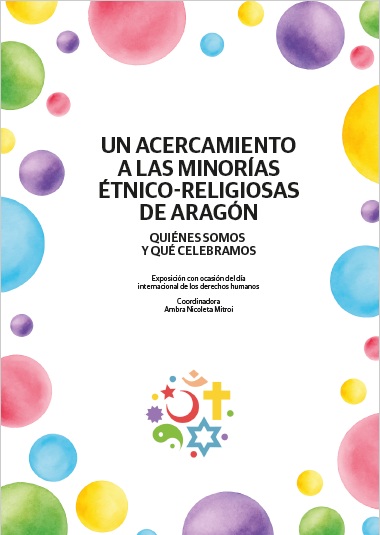
An approach to the ethno-religious minorities of Aragon.
On 12 December 2024, an event was organised, together with the Directorate General for Equal Opportunities, within the Department of Social Welfare and Family of the Government of Aragon, and…
Report on the situation of religious minorities in Aragon (2022)
Authors: Zoila Combalía and Alejandro González-Varas The incorporation of cultural-religious diversity is currently a fundamental pillar in the construction of a stable and sustainable society. The present…
New publication: «Migrations and Human Rights»
Authors: F. Arlettaz, C. Dariescu, N. del Olmo Vicen, G. A. Guardati and P. Jiménez Inglán. Presentation by A. González-Varas Ibáñez. Edited by the Laboratory of Freedom of Belief and...
Freedom of expression and hate speech on religious grounds
Editors: Zoila Combalía, Mª Pilar Diago, Alejandro González-Varas. March 2019. Publication resulting from the international congress on freedom of expression and hate speech on religious grounds, March 2019, University…
Freedom of Expression and Prevention of Violence and Discrimination based on Religion: The Perspective of Information Professionals
Editors: Zoila Combalía and Alejandro González-Varas. Zaragoza 2018 This publication has been produced within the framework of the MINECO R&D Project Freedom of expression and prevention of violence and discrimination by...
Book presentation: «The Teaching of Religion in Europe»
On the 4th of June, Monday, at 7 p.m., the book «La enseñanza de la …» will be presented at the Library of Aragon (C/ Dr. Cerrada, 22).